


When I transferred from MCC to Tarleton State, my credits came with me. A lot of students aren't so lucky. They pay to retake classes they've already passed.
That's one reason I welcome parts of the new federal accreditation rule finalized October 29. But if we're going to judge colleges on student outcomes, we need measures that reflect the students we serve.
The rule takes effect July 1, 2027. It makes it easier for colleges to switch accreditors and for new accreditors to get approved.
Last week at the ACCT Leadership Congress in Chicago, I attended a panel with representatives of the major accreditors. I was struck by how open they were to new accreditors entering the field. They welcomed the competition because it makes them better and pushes them to examine how they operate. Their concern was that the Department of Education might give new accreditors an easier path to approval, without the same rigorous review that existing accreditors go through.
The rule also requires reviews of completion, jobs and earnings, along with college policies on "intellectual diversity." Accreditation determines whether students can use federal aid, including Pell Grants. AGB's summary explains the changes.
Colleges won't be able to reject transfer credit just because of where it was earned. AACC and ACCT supported that change, and so do I. Texas already ties community college funding to outcomes under House Bill 8. I support that accountability, too.
The federal graduation rate, though, only counts students who start full-time and have never been to college. At MCC, that's fewer than half of our new students. Sixty-eight percent of all MCC students attend part-time.
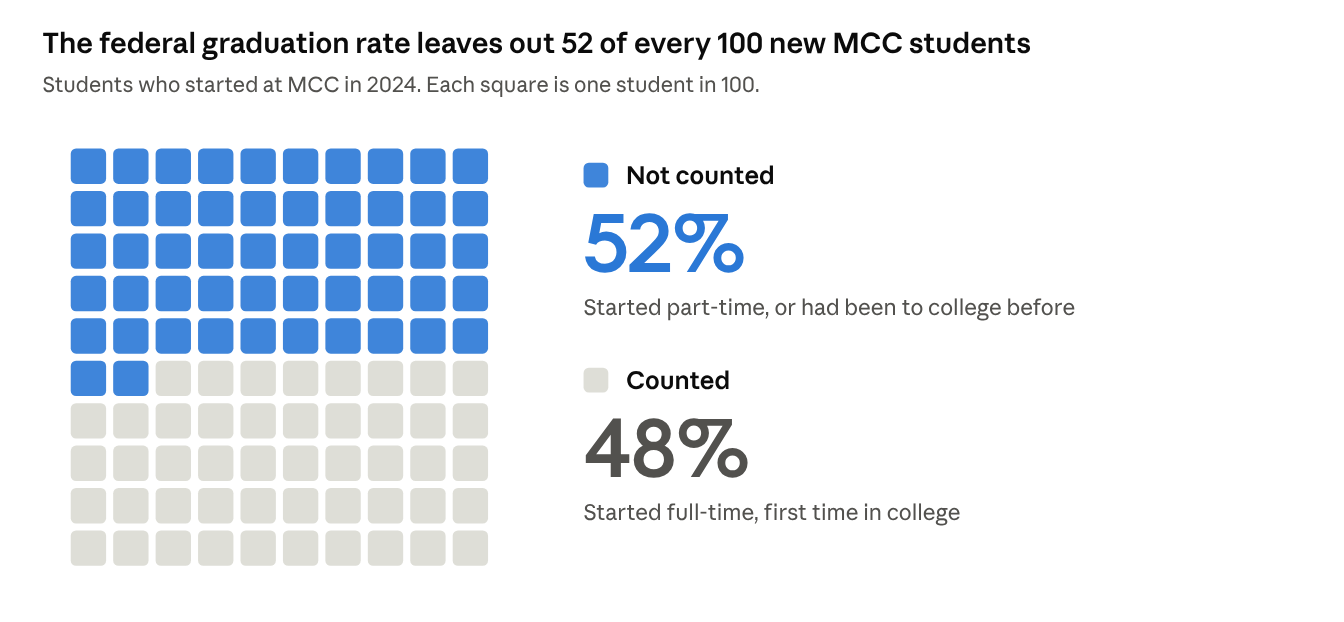
Source: U.S. Department of Education, IPEDS via College Navigator. Share of MCC’s entering students counted as full-time, first-time, 2024.
At MCC, the annual cost of attendance for an off-campus student is $18,885. Tuition and fees account for $3,660. The rest is books, food, housing and other living costs. We don't have dorms, but those expenses still go into one of the rule's measures of our results. AACC and ACCT asked the Department to use tuition and fees instead. The final rule kept cost of attendance.
A student who leaves MCC for a university before finishing here doesn't count as an MCC graduate, even if they go on to earn a bachelor's degree. I failed more than one semester at MCC before things clicked. On paper, I would have looked like a bad outcome.
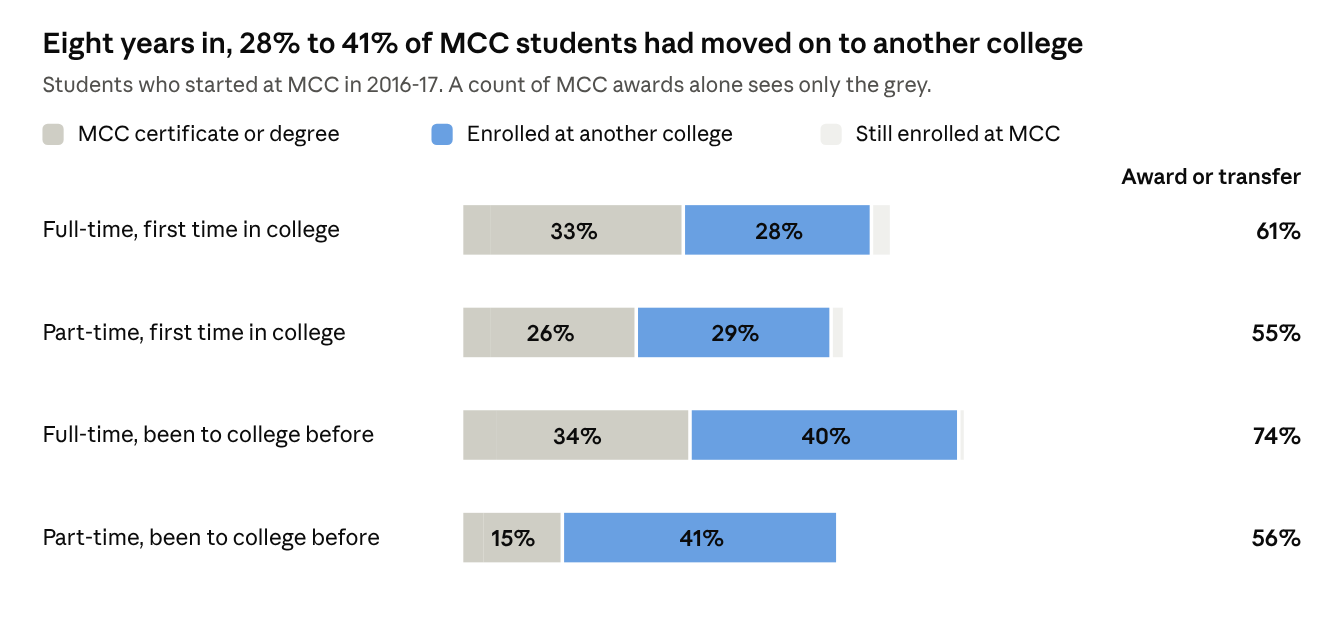
Source: U.S. Department of Education, IPEDS Outcome Measures via College Navigator. MCC students who entered in 2016-17, status after eight years.
I support free speech on campus. My question about the "intellectual diversity" review is who defines the standard and who decides whether a college meets it. Faculty and local boards need room to make academic decisions without having to guess which political views an accreditor expects them to represent.
Accreditors can start using the new rule January 1. Trustees should be asking our presidents: How do we track part-time and returning students? Are we giving transfer students credit for what they've already learned? What does our accreditor plan to change?
As always, there is much to do!
These views are my own as an individual trustee and do not represent the MCC Board of Trustees or any other organization or association mentioned here.
